Which compounds push psoriasis skin's gene changes back to normal?
A drug screen against a disease signature always finds hits. We asked which ones stand out from what any signature would find.
Psoriasis is a common, lifelong inflammatory disease of the skin. IL‑17 and IL‑23 drive it, and antibodies against them and against TNF have transformed treatment of severe disease.1
Psoriasis skin also has a well-studied gene-expression signature: genes switched up or down against healthy skin. A connectivity screen asks which compounds push those genes the other way in cultured cells, an idea from the Connectivity Map.2, 3 It's a fast way to find repurposing leads, and an easy way to fool yourself with a long list.
We used the Signature Reversal Screen workflow to screen compounds against the gene-expression signature of psoriasis skin.
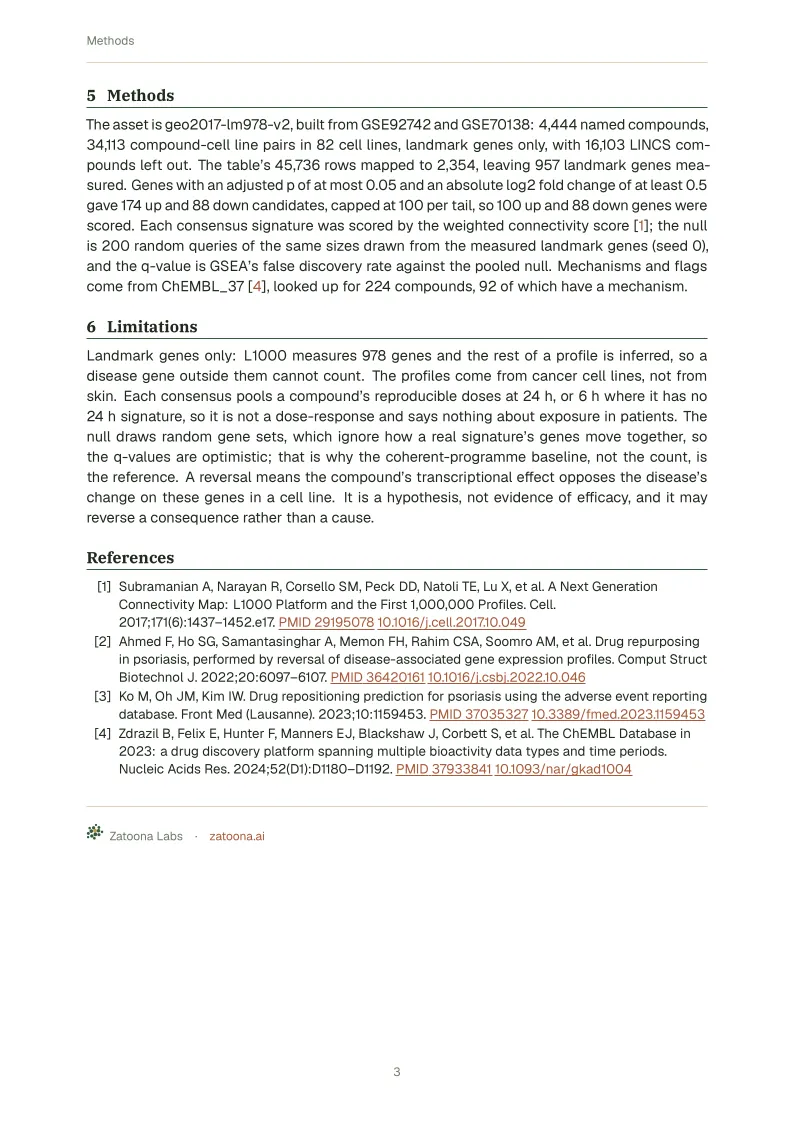
It built the signature from a public psoriasis skin expression set,4 kept the 100 up and 88 down genes that L1000 measures directly, and scored them against 4,444 compound signatures from the LINCS L1000 data on GEO.3, 5 It set the hits against queries built from random genes and from other compounds' own signatures, read each compound's mechanism from ChEMBL6 and took the disease's own drugs from Open Targets.7
PI3K and mTOR inhibitors lead
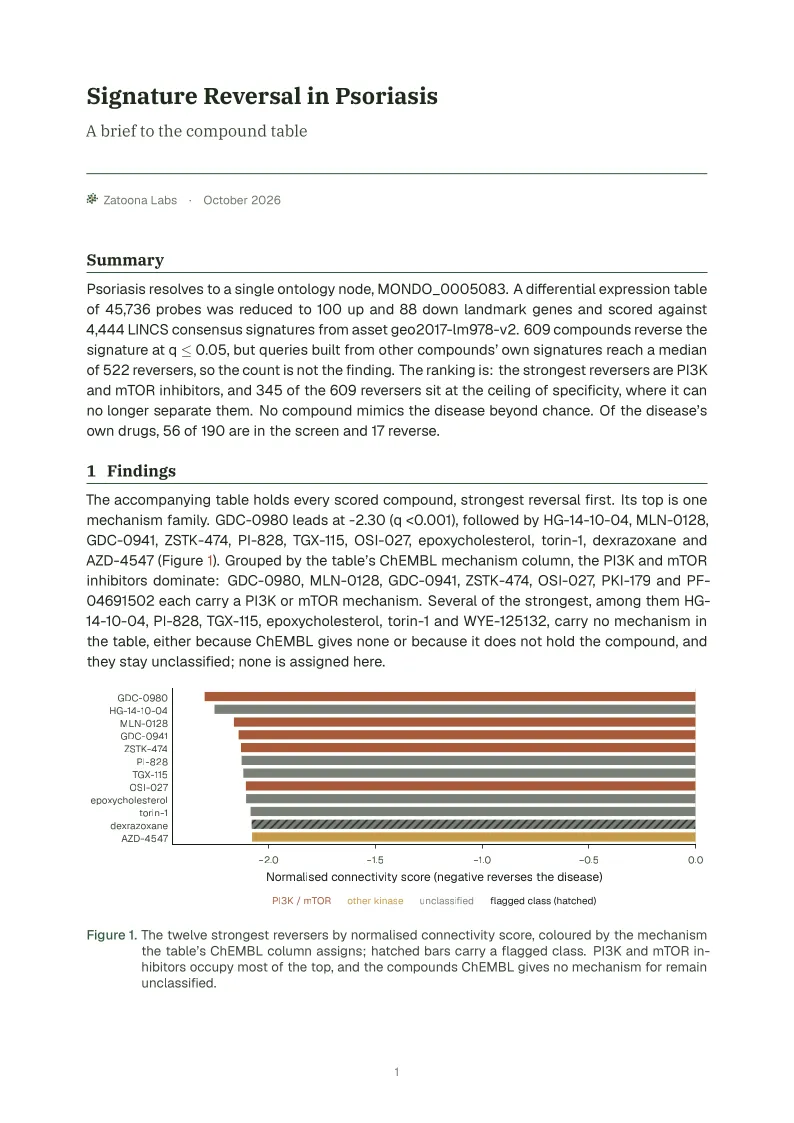
The strongest reversers are one mechanism family. GDC‑0980 leads at −2.30, and five of the top eight carry a PI3K or mTOR mechanism in ChEMBL: GDC‑0980, MLN‑0128, GDC‑0941, ZSTK‑474 and OSI‑027.6 Several others near the top have no mechanism there and stay unclassified.
They hold up across cell lines: GDC‑0980 reverses the signature in 14 of its 15, MLN‑0128 in 21 of 24.
Dexrazoxane, 11th, is hatched as a flagged class, a topoisomerase poison. Such drugs reverse many signatures by stopping cells growing. The figure colours it unclassified, though ChEMBL does give it a mechanism.6
The catch
609 compounds reverse the signature at q ≤ 0.05. A quick query would report that as 609 leads.
But queries built from other compounds' own signatures reach a median of 522 reversers, because any real, coherent signature connects to hundreds of compounds. So the count isn't the finding, the ranking is. And 345 of the 609 hit the ceiling of specificity, so that score can't rank the top either.
Psoriasis's own drugs, weakly
Open Targets lists 190 drugs tried for psoriasis.7 56 are in the screen and 17 reverse it, among them methotrexate (rank 212) and clobetasol (rank 282). Apremilast and tofacitinib don't.
Across the 56, the AUC is 0.61, a little above chance and weak evidence. 132 of the drugs, the biologics among them, were never profiled, so missing from the screen doesn't mean they fail it.
Limitations
- The profiles come from cancer cell lines, not skin; of the main lines, only A375, a melanoma, is skin.
- L1000 measures 978 genes directly, so a disease gene outside them can't count.
- Random-gene nulls make q-values optimistic, which is why real signatures are the yardstick.
- A reversal is a hypothesis about gene effects in cells, not evidence that a drug treats psoriasis.
Sources
- 1Griffiths CEM, Armstrong AW, Gudjonsson JE, et al. Psoriasis. Lancet. 2021;397(10281):1301-1315.
- 2Lamb J, Crawford ED, Peck D, et al. The Connectivity Map: using gene-expression signatures to connect small molecules, genes, and disease. Science. 2006;313(5795):1929-1935.
- 3Subramanian A, Narayan R, Corsello SM, et al. A Next Generation Connectivity Map: L1000 Platform and the First 1,000,000 Profiles. Cell. 2017;171(6):1437-1452.e17.
- 4NCBI Gene Expression Omnibus. GSE13355, psoriasis skin expression set.
- 5NCBI Gene Expression Omnibus. GSE92742 and GSE70138, LINCS L1000 profiles. No restrictions on use.
- 6Zdrazil B, Felix E, Hunter F, et al. The ChEMBL Database in 2023: a drug discovery platform spanning multiple bioactivity data types and time periods. Nucleic Acids Res. 2024;52(D1):D1180-D1192. ChEMBL 37 data, CC BY-SA 3.0.
- 7Ochoa D, Hercules A, Carmona M, et al. The next-generation Open Targets Platform: reimagined, redesigned, rebuilt. Nucleic Acids Res. 2023;51(D1):D1353-D1359. Open Targets Platform 26.09 data, CC0.
Have a research question like this?
Zatoona Labs is in early access. Tell us about your research question and we'll be in touch.