Does human genetics support today's treatments for giant cell arteritis?
Human genetics is one of the better guides to which drug targets will work. We checked where it points for giant cell arteritis, and whether today's drugs act there.
Giant cell arteritis is the most common vasculitis in people aged 50 and over. It inflames the aorta, its branches and the arteries of the head, bringing headaches, jaw pain on chewing and trouble seeing. Treated late, it can take sight for good.1
Steroids are the standard treatment, but long courses bring diabetes, bone loss and cataracts, and the disease often returns as the dose comes down.1, 2 Since 2017 the US has approved tocilizumab for it,3 and since 2025 upadacitinib.4 Picking targets with human genetic support could double a drug's chance of success in development,5 so it's fair to ask whether these two have it.
We used the Genetic Evidence for Repurposing workflow to find every gene with genetic evidence for giant cell arteritis, and the drugs that act on them.
It took the genetic evidence from Open Targets 26.096 and each drug's action from ChEMBL,7 then looked for a recorded direction of effect: whether a drug pushes its gene the way the genetics favours. It checked the release against the GWAS Catalog8 and pulled the disease's registered trials from ClinicalTrials.gov and the EU register (CTIS).9, 10
Today's drugs hit none of the 15
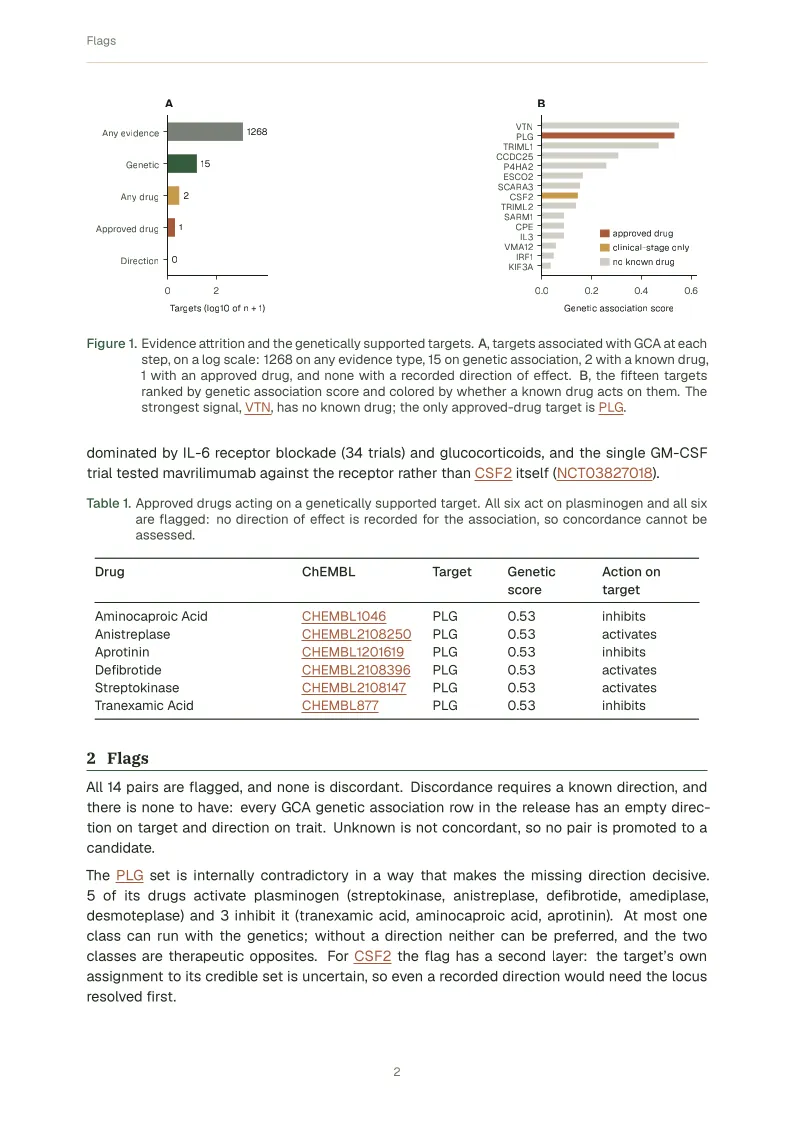
Open Targets ties 1,268 targets to giant cell arteritis on any evidence, but only 15 on genetic association, all of it from GWAS.6 They sit in 6 loci, and 13 of the 15 share a locus with another gene.
Neither drug it lists as approved for the disease acts on one of them: not tocilizumab's IL6R, nor upadacitinib's JAK1, JAK2, JAK3 and TYK2. The trials follow the drugs: 34 of the 208 trials registered for it involve IL‑6 receptor blockade.9, 10
The catch
Sort the 1,268 by Open Targets' overall score and IL6R comes first, at 0.578. It looks as if genetics backs tocilizumab. It doesn't: IL6R has no genetic score at all, and the overall score leans on literature mining.6
Ranking on that score and calling the result genetic would be circular, so we ranked on the genetic association score alone.
Plasminogen's drugs pull both ways
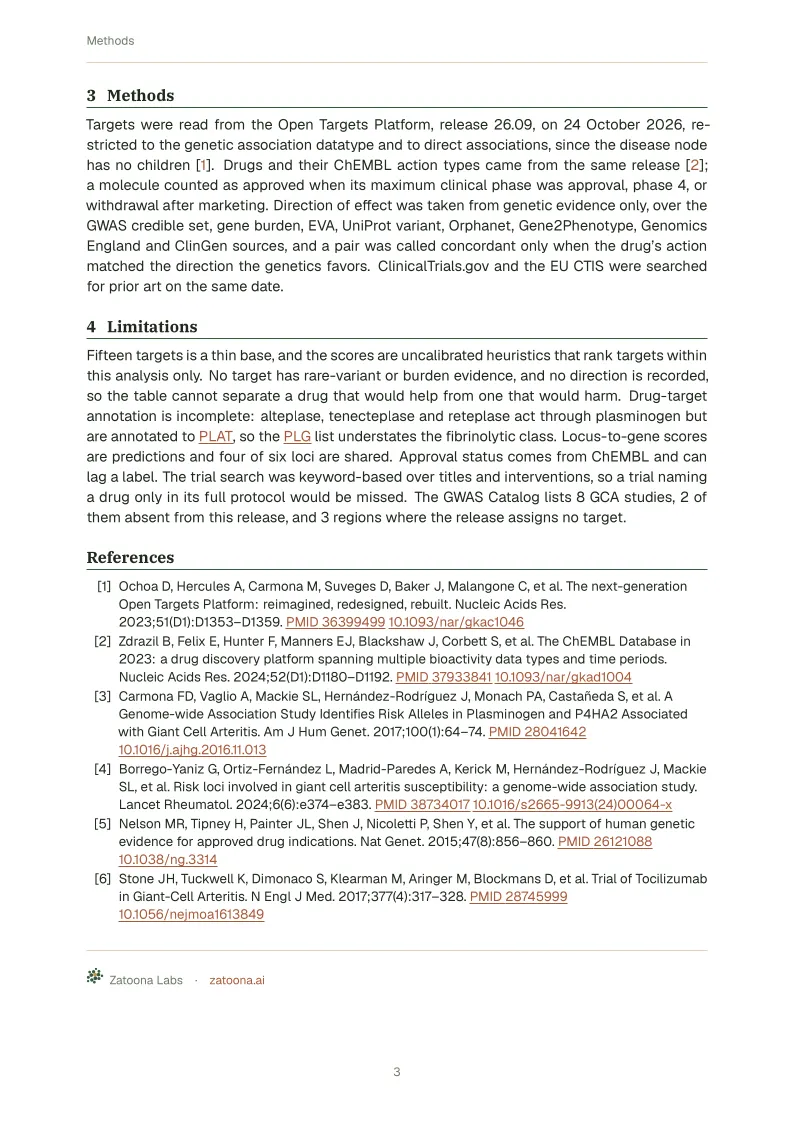
Only two of the 15 genes have drugs. GM‑CSF (CSF2) has 6, none approved. Plasminogen (PLG) has 8, 6 of them approved, and they split. Five activate it (streptokinase, anistreplase, defibrotide, amediplase, desmoteplase) and three inhibit it (tranexamic acid, aminocaproic acid, aprotinin).7
At most one side can fit the genetics, and the genetics doesn't say which: Open Targets records no direction of effect for any association with the disease. None of the 14 drug-gene pairs counts as a candidate.
The strongest signal has no target
The disease's strongest genetic association is the HLA class II region, in a large 2015 study and again in the 2017 GWAS that found PLG.11, 12
Open Targets 26.09 holds three studies that report it, but assigns the region no target, so it isn't among the 15. It is one of 3 GWAS Catalog regions left without one; the other two, near HLA‑B and MFGE8, come from the 2024 GWAS.8, 13 A search that starts from the gene list never sees them.
Limitations
- Fifteen genes is a thin base, and locus-to-gene scores are predictions: 4 of the 6 loci are shared.
- Alteplase, tenecteplase and reteplase act through plasminogen but are annotated to PLAT, so PLG's drug list runs short.
- The trial search matched drug names in titles and interventions, so a drug named only in a protocol is missed.
- Two of the GWAS Catalog's 8 studies of the disease aren't in this Open Targets release.
Sources
- 1Ness T, Bley TA, Schmidt WA, et al. The diagnosis and treatment of giant cell arteritis. Dtsch Arztebl Int. 2013;110(21):376-385.
- 2Stone JH, Tuckwell K, Dimonaco S, et al. Trial of Tocilizumab in Giant-Cell Arteritis. N Engl J Med. 2017;377(4):317-328.
- 3US Food and Drug Administration. Supplement approval letter, BLA 125472/S-024: Actemra (tocilizumab) for adults with giant cell arteritis. 22 May 2017.
- 4US Food and Drug Administration. Supplement approval letter, NDA 211675/S-025: Rinvoq (upadacitinib) for adults with giant cell arteritis. 28 April 2025.
- 5Nelson MR, Tipney H, Painter JL, et al. The support of human genetic evidence for approved drug indications. Nat Genet. 2015;47(8):856-860.
- 6Ochoa D, Hercules A, Carmona M, et al. The next-generation Open Targets Platform: reimagined, redesigned, rebuilt. Nucleic Acids Res. 2023;51(D1):D1353-D1359. Open Targets Platform 26.09 data, CC0.
- 7Zdrazil B, Felix E, Hunter F, et al. The ChEMBL Database in 2023: a drug discovery platform spanning multiple bioactivity data types and time periods. Nucleic Acids Res. 2024;52(D1):D1180-D1192. ChEMBL data through Open Targets, CC BY-SA 3.0.
- 8Cerezo M, Sollis E, Ji Y, et al. The NHGRI-EBI GWAS Catalog: standards for reusability, sustainability and diversity. Nucleic Acids Res. 2025;53(D1):D998-D1005.
- 9ClinicalTrials.gov, US National Library of Medicine. clinicaltrials.gov, accessed 24 October 2026.
- 10Clinical Trials Information System (CTIS), European Medicines Agency. euclinicaltrials.eu, accessed 24 October 2026.
- 11Carmona FD, Mackie SL, Martín JE, et al. A large-scale genetic analysis reveals a strong contribution of the HLA class II region to giant cell arteritis susceptibility. Am J Hum Genet. 2015;96(4):565-580.
- 12Carmona FD, Vaglio A, Mackie SL, et al. A Genome-wide Association Study Identifies Risk Alleles in Plasminogen and P4HA2 Associated with Giant Cell Arteritis. Am J Hum Genet. 2017;100(1):64-74.
- 13Borrego-Yaniz G, Ortiz-Fernández L, Madrid-Paredes A, et al. Risk loci involved in giant cell arteritis susceptibility: a genome-wide association study. Lancet Rheumatol. 2024;6(6):e374-e383.
Have a research question like this?
Zatoona Labs is in early access. Tell us about your research question and we'll be in touch.